
Written by Tushar Singh (Director, Doctor's Chamber) · Reviewed by Amit Singh (HOD, MBBS & MD/MS Admissions) · Last updated .
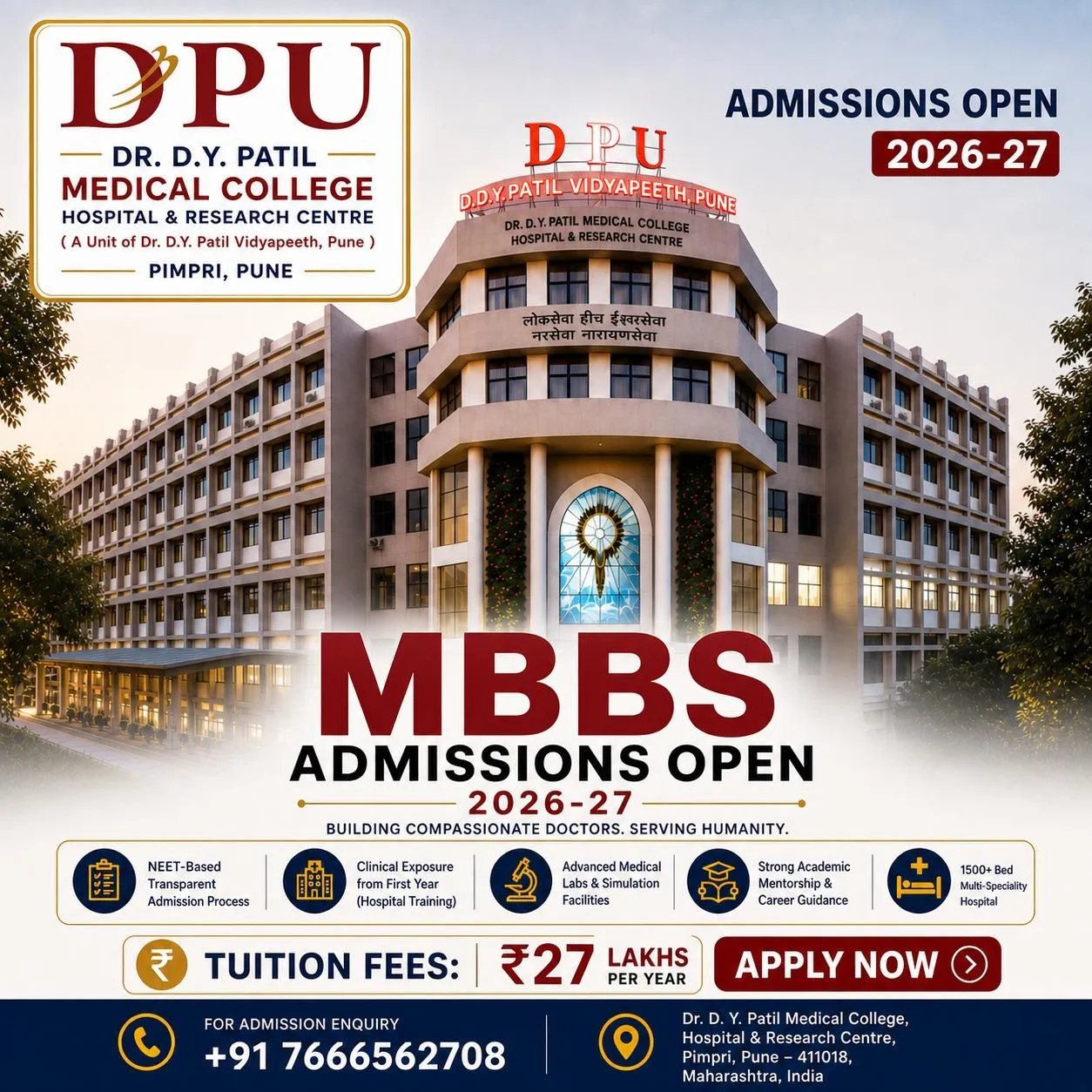
Dr. D.Y. Patil Medical College, Hospital & Research Centre at Pimpri, Pune — a constituent unit of Dr. D.Y. Patil Vidyapeeth (DPU) — is the institution every parent shortlists when they want premium private medical education for their child without leaving the safety net of NMC-recognised Indian counselling. Tuition is firmly in the upper bracket of Deemed Universities, but for 2026 DPU has officially removed its annual increment clause and locked tuition at a flat ₹27,00,000 per year for the full 4.5-year course — a structural change that puts parents in command of their long-term budget. This guide is an exhaustive 2026 walkthrough of DPU Pune admission: the new flat-fee structure, NRI rates in USD, expected NEET UG cutoffs by rank and marks, every MCC counselling step, the ₹2 lakh security deposit and forfeiture trap, the complete document checklist, eligibility and domicile rules, a full five-year cost model, and the strategic decisions that separate confirmed admissions from forfeited deposits.
AI Snapshot — DPU Pune 2026 at a Glance
For the 2026-27 academic session, securing an MBBS seat at the prestigious Dr. D.Y. Patil Medical College, Hospital & Research Centre (DPU), Pune requires strategic financial planning and participation in centralised MCC counselling. The non-negotiable headlines:
- University Status — Deemed-to-be University (recognised under Section 3 of UGC Act, 1956) with a coveted NAAC A++ rating.
- Counselling Authority — 100% centralised online counselling conducted by the Medical Counselling Committee (MCC) via mcc.nic.in. There are no state-level or direct admissions.
- Total Intake — 250 MBBS seats (85% Management Quota, 15% NRI Quota).
- Annual Tuition Fee — ₹27,00,000 per year for the Management Quota under a flat fee model; the annual increment has been officially removed for 2026.
- Total Tuition Cost — Flat ₹1.21 Crores for the entire 4.5-year academic duration.
- NRI Quota Fees — $60,000 to $65,000 USD per year.
- Expected Cutoff — Generally ranges between 1,80,000 and 2,30,000 All India Rank (approx. 430 to 460 NEET marks) for Management seats.
- Key Advantage — A 1,500+ bed multi-speciality teaching hospital right on campus, guaranteeing exceptional Year-1 clinical exposure in the heart of Pune's Pimpri-Chinchwad industrial belt.
Navigating DPU's admission process requires more than just a qualifying NEET score; it demands absolute financial clarity and strict adherence to the MCC's centralised counselling forfeiture rules. This meticulously detailed guide breaks down the updated, increment-free financial commitments required for DPU, projects the expected NEET UG cutoffs, and provides a flawless roadmap for choice-filling so you secure your seat without losing your ₹2 lakh security deposit.
Why DY Patil Pune?
When medical aspirants and their parents discuss premium, top-tier private medical education in India, DPU is inevitably at the top of the list. Located in the bustling, well-connected hub of Pimpri-Chinchwad, the institution has established itself as a titan of medical academia — state-of-the-art infrastructure, advanced robotic surgery training centres, and a massive daily patient footfall that transforms students into highly competent clinicians.
- Established Deemed University — Dr. D.Y. Patil Vidyapeeth is recognised under Section 3 of UGC Act, 1956.
- 1,500+ bed multi-speciality teaching hospital on campus — heavy patient flow ensures real clinical exposure from the second year.
- Pimpri-Chinchwad location — well-connected industrial belt of Pune; full urban + rural patient demographic.
- NEET-Based transparent admission through MCC central counselling — no donations or back-door admissions.
- Strong PG & super-specialty presence — UG students learn alongside MD/MS and DM/MCh trainees in active clinical departments.
Eligibility & Domicile Rules for DPU Pune
Because DPU is a Deemed-to-be University filling 100% of its seats through MCC, there is one crucial fact that simplifies planning for out-of-state families: there is no domicile or state-of-residence requirement. A student from Uttar Pradesh, Rajasthan, Bihar, Gujarat, Kerala or anywhere else competes on exactly the same footing as a Maharashtra candidate. This is the single biggest difference between Deemed-university MBBS admission through MCC and state-quota MBBS, where 85% of seats are ring-fenced for local-domicile students.
- Nationality — Indian citizens (for Management/Paid seats); NRIs, OCIs, PIOs and foreign nationals (for the NRI quota).
- Qualifying exam — Pass in Class 12 (or equivalent) with Physics, Chemistry, Biology/Biotechnology and English as compulsory subjects.
- Minimum marks in Class 12 PCB — 50% aggregate for General/EWS, 40% for OBC/SC/ST, and 45% for candidates with benchmark disability (as per NMC norms).
- NEET UG 2026 — Mandatory. You must clear the qualifying percentile: 50th for General/EWS, 40th for OBC/SC/ST, and 45th for PwBD-General.
- Minimum age — Candidate must have completed 17 years of age on or before 31 December of the year of admission.
- Upper age limit — There is currently no upper age limit for NEET UG / MBBS admission.
Category certificates (OBC/SC/ST/EWS) determine only the NEET qualifying percentile and reservation eligibility in government counselling; at a Deemed university the seats are Management and NRI, so category does not reduce the tuition fee. A reserved-category student still pays the full ₹27 lakh/year unless they win a separate scholarship.
2026–27 Fee Structure
DPU follows the Deemed University fee model — 100% MCC counselling, fees paid annually for 4.5 years. Understanding this structure is crucial for calculating your exact Return on Investment. Because DPU is a highly autonomous Deemed-to-be University, it does not receive state funding; the institution relies on tuition to maintain its NAAC A++ standards, pay elite faculty and run its 1,500+ bed charitable hospital. As a prospective student, you are committing to a 4.5-year financial cycle followed by a 1-year mandatory rotatory internship.
| Component | Amount | Frequency |
|---|---|---|
| Tuition Fee | ₹ 27,00,000 | Per Year (4.5 years) |
| Caution Deposit (Refundable) | ₹ 1,00,000 | One-time |
| Hostel + Mess (typical) | ₹ 2,50,000 – ₹ 3,50,000 | Per Year |
| NRI Quota Tuition | $ 60,000 – $ 65,000 | Per Year |
Total course tuition (4.5 years) ≈ ₹ 1.21 Crore for Management quota. NRI total ≈ $270,000–$290,000.
DY Patil Pune MBBS Fees 2026 — Quota-Wise Summary Table
A side-by-side summary of the DPU Pune (Pimpri) MBBS fees already detailed above, so you can compare the Management and NRI quotas at a glance. All figures are the same confirmed flat-fee numbers used throughout this page.
| Quota | Annual Tuition | Total Course Tuition (4.5 yrs) | Seats |
|---|---|---|---|
| Management / Paid Quota | ₹ 27,00,000 (flat, no annual hike) | ₹ 1,21,50,000 (≈ ₹ 1.21 Cr) | 85% (≈ 213) |
| NRI Quota | $ 60,000 – $ 65,000 | ≈ $ 270,000 – $ 290,000 | 15% (≈ 37) |
| One-time Caution Deposit (refundable) | ₹ 1,00,000 | One-time | — |
| Hostel + Mess (typical) | ₹ 2,50,000 – ₹ 3,50,000 | Per year | — |
All-in Management-quota cost with hostel across the full course works out to roughly ₹1.40–₹1.46 Crore. Always confirm the live figures on your year's official DPU fee letter and the MCC notification before paying.
Management / Paid Quota — The Flat Fee Advantage
The Management Quota comprises 85% of the total seats (approx. 213 seats) and is open to any NEET-qualified Indian citizen, regardless of their home state. The major 2026 update: DPU has officially removed the annual increment clause. The tuition fee is now a flat rate for the entire duration of the course, providing parents with massive relief from unpredictable, compounding costs.
- Base Annual Tuition Fee — ₹ 27,00,000 per year.
- Total Course Tuition (4.5 Years) — ₹ 1,21,50,000 (≈ ₹ 1.21 Crores). Calculated as ₹27 L × 4 years + ₹13.5 L for the final 6 months.
- One-Time Caution Deposit — ₹ 1,00,000, refundable at the end of the course, payable at the time of Round 1 physical reporting.
- Hostel & Mess Charges — DPU mandates or highly encourages on-campus living. Depending on choice of AC / non-AC and single / twin-sharing rooms, expect ₹ 2,50,000 – ₹ 3,50,000 per year.
- University Eligibility & Exam Fees — approximately ₹ 50,000 to ₹ 80,000 annually for library access, gymkhana, and university-level exams.
When factoring in 4.5 years of premium hostel accommodations, the total, fixed financial package lands at approximately ₹ 1.35 Crores to ₹ 1.40 Crores, with zero hidden hike surprises.
NRI Quota Fee Breakdown
15% of the total intake (approx. 37 seats) is strictly reserved for Non-Resident Indians, PIOs, OCIs and foreign nationals.
- Annual Tuition Fee — $ 60,000 to $ 65,000 USD per year.
- Total Course Tuition — approximately $270,000 to $290,000 USD for 4.5 years.
- Payment Terms — NRI fees must be paid via foreign wire transfer or from an NRE / NRO bank account. Converting to Indian Rupees, the total NRI package generally exceeds ₹2.2 Crores to ₹2.4 Crores depending on dynamic exchange rates.
⚠️ The 2026 Flat-Fee Change — Read Carefully
Historically, most DPU fee circulars included a 5–10% annual increment on tuition. For the 2026-27 cycle, DPU has officially removed that clause and locked tuition at a flat ₹27 L/year for the full 4.5-year course. Always re-confirm the increment policy in writing on your year's official fee circular before signing — fee policies can be revised between counselling cycles, and earlier batches may still be on incremental schedules.
Five-Year Cost Model — What You Actually Pay
The sticker tuition figure of ₹27 lakh tells only part of the story. To budget responsibly, you have to add hostel, mess, university charges and the one-time refundable deposits, then spread the picture across the full 4.5-year course plus the mandatory internship year. The table below models a realistic, all-inclusive Management-quota cost for a student staying in on-campus accommodation. Numbers for hostel and university charges are mid-range estimates drawn from DPU's typical published bands; tuition is the confirmed flat ₹27 lakh.
| Year | Tuition | Hostel + Mess + Univ. charges (approx.) | Running Total |
|---|---|---|---|
| Year 1 (+ ₹1 L caution, one-time) | ₹ 27,00,000 | ₹ 3,50,000 – ₹ 4,30,000 | ≈ ₹ 31.5 L – ₹ 32.3 L |
| Year 2 | ₹ 27,00,000 | ₹ 3,00,000 – ₹ 4,30,000 | ≈ ₹ 61.5 L – ₹ 63.6 L |
| Year 3 | ₹ 27,00,000 | ₹ 3,00,000 – ₹ 4,30,000 | ≈ ₹ 91.5 L – ₹ 94.9 L |
| Year 4 | ₹ 27,00,000 | ₹ 3,00,000 – ₹ 4,30,000 | ≈ ₹ 1.22 Cr – ₹ 1.26 Cr |
| Final 6 months (4.5-yr course) | ₹ 13,50,000 | ₹ 1,50,000 – ₹ 2,15,000 | ≈ ₹ 1.37 Cr – ₹ 1.42 Cr |
| Internship year (12 months) | Nil (stipend paid to you) | ₹ 3,00,000 – ₹ 4,30,000 living | ≈ ₹ 1.40 Cr – ₹ 1.46 Cr |
So the all-in, out-of-pocket cost of completing MBBS at DPU Pune lands in the region of ₹1.40 Crore to ₹1.46 Crore for a Management-quota student in hostel — with the comfort that, thanks to the flat-fee freeze, this figure will not balloon mid-course the way an incremental schedule would. Day-scholars who live with family in Pune can shave roughly ₹14–18 lakh off the hostel/mess component over the course.
💡 Stipend & Internship
During the compulsory one-year rotatory internship, interns at DPU's attached hospital are paid a monthly stipend (set periodically by the institution / state norms and revised from time to time). The internship year carries no tuition — you are a working junior doctor under supervision, not a fee-paying student. Always confirm the prevailing stipend figure for your batch directly with the college, as it is revised across cycles.
Bond & Service Obligation
One reason families choose a Deemed university like DPU over a government medical college is the absence of a compulsory rural-service bond. Maharashtra government MBBS seats typically carry a multi-year service bond (or a heavy bond-breaking penalty running into many lakhs) requiring graduates to serve in rural or state-designated postings. DPU, being a private Deemed institution, does not impose a state rural-service bond on its MBBS graduates — once you complete your course and internship, you are free to pursue PG entrance, practice, or work abroad without a state lock-in. This freedom is a meaningful, if often overlooked, part of the value proposition behind the higher tuition. (Confirm the exact bond clause in your admission letter, as institution-level service conditions can be added in any cycle.)
Seat Matrix
- Total annual intake: 250 seats (typical Deemed allotment).
- Management / Paid Quota: 85% (≈ 213 seats).
- NRI Quota: 15% (≈ 37 seats).
Unfilled NRI seats are typically converted to Management Quota in Mop-Up rounds. During the Stray Vacancy round, these converted seats are offered to Indian students at the standard ₹27 Lakh/year fee structure — per Supreme Court guidelines.
Expected NEET Cutoffs for DPU Pune (2026)
When predicting cutoffs for Deemed Universities, the standard rule of economics applies: cutoffs are inversely proportional to tuition fees. Because the financial barrier to entry at DY Patil Pune is exceedingly high, a large chunk of high-scoring students is automatically filtered out. This makes DPU an exceptional, world-class safety net for students who scored in the mid-range but possess strong financial backing.
Management Quota Cutoff Analysis
Historically, DPU maintains a very stable cutoff bracket. It does not drop as low as some of the newer deemed universities in the south, purely because the "Pune location" and the "DY Patil brand" generate immense demand among the business and medical elite of North and West India.
- Expected Round 1 Closing Rank: 1,80,000 – 2,30,000 All India Rank.
- Expected NEET Marks: 430 – 460 marks.
- Strategic Note: if you score around 450 marks, DPU Pune should be your primary target in Round 1 choice filling. Do not wait for Round 2 — seats fill rapidly with students who panic after missing out on lower-fee colleges.
NRI Quota Cutoff Analysis
The USD pricing and the brutally strict documentation required by the MCC make the NRI applicant pool incredibly small.
- Expected Cutoff: often settles just above the NEET qualifying percentile.
- Expected NEET Marks: if you hold valid NRI sponsorship documents and score anywhere between 150 and 300 marks, securing an NRI seat at DPU is highly probable in Round 1 or Round 2 (300+ marks comfortably secures a seat).
Mop-Up & Stray Vacancy Anomalies
If the 37 NRI seats are not filled by the Mop-Up round due to a lack of eligible NRI applicants, Supreme Court guidelines dictate that these seats be converted to Management Quota seats. During the Stray Vacancy round, these converted seats are offered to Indian students at the standard ₹27 Lakh/year fee structure — opening a final window for candidates who missed earlier rounds.
Cutoffs vary year-to-year. Always verify with MCC's live counselling notification before locking choices.
How to Read These Cutoffs Without Getting Burned
The biggest mistake mid-range scorers make is treating a "closing rank" as a guarantee. A closing rank is simply the rank of the last student who happened to accept a seat in that round — it shifts every year with the size of the applicant pool, the number of seats added or converted, and how aggressively students up-grade between rounds. Use these bands as a planning tool, not a promise:
- If you scored 450+ (≈ AIR under 1,90,000): DPU Pune is a realistic Round 1 target. Place it high and lock confidently.
- If you scored 430–450: You are inside the historical band but on the edge. List DPU Pune plus two or three lower-fee deemed safeties (Karnataka/Maharashtra) below it so a single bad allotment doesn't leave you seatless.
- If you scored 400–430: A DPU seat is more likely in Mop-Up/Stray rounds when seats convert and high-scorers have already exited. Stay registered through every round.
- NRI applicants (150–300+): With clean sponsorship papers a seat is very achievable; the limiting factor is documentation quality, not your score.
Quota & Category Explained
Deemed-university seat language confuses many first-time applicants because it does not work like state counselling. At DPU there are effectively two seat pools, and your category (OBC/SC/ST/EWS) does not create a separate, cheaper seat the way it does in a government college. For a fuller breakdown of how these pools differ across colleges, see our guide on the Management and NRI quota MBBS seats.
- Management / Paid Quota (85%, ≈213 seats) — Open to all NEET-qualified Indian citizens. Allotted purely on NEET merit within the deemed-counselling pool. Fee: flat ₹27 lakh/year. There is no SC/ST/OBC fee concession on these seats; the category only affects the qualifying percentile you needed to clear NEET.
- NRI Quota (15%, ≈37 seats) — Reserved for NRIs, OCIs, PIOs and foreign nationals with a valid first/second-degree sponsor. Fee in USD ($60,000–$65,000/year). Allotted on merit within the much smaller NRI pool, which is why scores as low as 150–300 can secure a seat.
- EWS / Reserved categories — Relevant for NEET qualification and for government/AIQ seats elsewhere, but at DPU they do not reduce tuition. Plan your budget on the full Management fee unless you separately qualify for an institutional or external scholarship.
Unfilled NRI seats convert to Management in later rounds (see Mop-Up note above), which is the one mechanism by which the 85:15 ratio can shift in a given year.
2026 Counselling Timeline & Round-Wise Strategy
MCC runs deemed counselling in the same four-stage structure every year — Round 1, Round 2, Mop-Up, and Stray Vacancy. Exact dates are published only when NEET UG results are declared, so treat the sequence below as the shape of the calendar rather than fixed dates. The strategic behaviour in each round matters far more than the dates.
- NEET UG 2026 result & rank declaration — Counselling cannot start until NTA publishes ranks. Keep your scorecard, rank letter and category certificate ready the day results drop.
- MCC registration + ₹2.05 lakh payment — Opens shortly after results. Register under "Deemed Universities," pay the ₹5,000 non-refundable fee plus ₹2,00,000 refundable security deposit.
- Round 1 — choice filling, locking, allotment, reporting — Your "free exit" round. Treat it as your safest chance to grab DPU if it is your dream college.
- Round 2 — fresh registration or up-gradation — The forfeiture rules now bite. Only fill DPU here if you are financially committed.
- Mop-Up round — Seats left vacant (including converted NRI seats) are offered. Good window for 400–430 scorers.
- Stray Vacancy round — Final fill of leftover seats, often institute-level. Last realistic chance; non-joining penalties are severe.
Round-by-Round Game Plan
Round 1 — be brave. Because Round 1 carries a genuine free exit (you can decline DPU without losing your deposit), there is no downside to placing it at Preference #1 if it is your true first choice and the budget is arranged. Do not "wait and watch" hoping for a cheaper college in Round 2 — DPU seats fill fast in Round 1 as financially-ready families lock in.
Round 2 — commit or skip. The free exit is gone. If you let DPU sit high on your Round 2 list "just in case," and it gets allotted, you are legally bound to join or forfeit ₹2,00,000. Only keep DPU on your Round 2 list if you are 100% prepared to pay and report. If you are merely hoping to up-grade away from a cheaper seat you already hold, understand that up-gradation surrenders your current seat.
Mop-Up & Stray — for opportunists, not gamblers. These rounds suit candidates with strong budgets and slightly lower scores, because high-scorers have largely exited and converted NRI-to-Management seats appear. But the penalty for non-joining is at its harshest here (deposit forfeiture and possible debarment from next year's counselling), so enter only when you are ready to sign.
Complete Admission & Counselling Procedure for 2026
Dr. D.Y. Patil Medical College Pune does not conduct any private counselling, entrance exams or offline admissions. 100% of the seats are allotted through the central Medical Counselling Committee (MCC) software. Any agent promising you a "direct seat" outside of mcc.nic.in is orchestrating a scam.
Step 1 — NEET UG Qualification
You must appear for NEET UG 2026 and clear the minimum qualifying percentile set by the NTA and NMC: 50th percentile for General / EWS, 40th percentile for OBC / SC / ST. If you are disqualified you cannot participate, regardless of your budget.
Step 2 — MCC Portal Registration
Once the DGHS releases the official counselling schedule, visit the official MCC counselling portal at mcc.nic.in.
- Click "UG Medical Counselling" → "New Registration."
- Crucial selection: when the portal asks you to select your counselling type, check the box for "Deemed Universities." If you only check "All India Quota," DY Patil Pune will not appear in your choice-filling list.
Step 3 — Payment of the ₹2 Lakh Security Deposit
To prevent non-serious candidates from blocking premium Deemed University seats, the government mandates a heavy upfront payment:
- Non-Refundable Registration Fee: ₹ 5,000.
- Refundable Security Deposit: ₹ 2,00,000.
- Total Payment: ₹ 2,05,000 via Net Banking, Credit or Debit Card.
The ₹2 Lakh is refunded to your account months after the counselling ends, provided you don't violate the forfeiture rules described below.
Step 4 — Choice Filling & Locking
When the choice-filling window opens you will see a list of over 50 Deemed Universities.
- Search for "Dr. D.Y. Patil Medical College, Pimpri, Pune" — and do not confuse it with DY Patil Navi Mumbai or DY Patil Kolhapur, which are separate campuses with different fee structures.
- Add it to your preference list. If DPU is your dream college and you have the budget, place it at Preference #1.
- Lock your choices using your password before the server deadline. If you forget, the system auto-locks at the deadline.
Step 5 — Round 1 Allotment & the "Free Exit"
The MCC algorithm will process ranks and choices. If you are allotted DPU Pune:
- Download your Provisional Allotment Letter from the MCC portal.
- Free Exit Rule: Round 1 gives you a safety net. If you decide the ₹27 Lakh fee is too high and change your mind, you can simply ignore the allotment. You will not lose your ₹2,00,000 deposit, and you can participate fresh in Round 2.
Step 6 — Physical Reporting at Pimpri Campus
If you accept the Round 1 seat, you have a tight 5-to-7-day window to travel to the Pimpri campus in Pune:
- Present yourself at the Dean's office for a physical document and biometric check.
- Undergo the institutional medical fitness test.
- Fee Payment: submit the first year's tuition fee (₹27,00,000) and the caution deposit (₹1,00,000) via Demand Draft (DD) or RTGS drawn in favour of the college, exactly as specified on the DPU official website.
Step 7 — Round 2 / Mop-Up / Stray Vacancy — The Forfeiture Trap
If you participate in Round 2 looking for an upgrade, or if you register fresh in Round 2 and are allotted DPU Pune, you must join the college.
⚠️ The ₹2 Lakh Forfeiture Rule
If you are allotted DPU in Round 2 and fail to physically report with the ₹27 Lakh tuition fee, the MCC will permanently confiscate your ₹2,00,000 security deposit. The same binding rule applies to Mop-Up and Stray Vacancy allotments — refusal can additionally result in debarment from the next year's NEET. The Round 1 "free exit" does not exist after Round 1.
Required Documents Checklist (Physical Reporting)
Missing a single original document can lead to immediate cancellation of your seat by the nodal officer. Carry the originals in a secure folder along with 3 – 4 sets of self-attested photocopies.
- MCC Documents — Provisional Allotment Letter generated online.
- NTA Documents — NEET UG 2026 Admit Card and final Scorecard / Rank Letter.
- Academic Proofs — Class 10 Certificate (for Date of Birth), Class 12 Marksheet & Passing Certificate.
- Institutional Transfers — School / College Leaving Certificate (Transfer Certificate) and Migration Certificate from your 12th board.
- Identification — Aadhaar Card or PAN Card of the student.
- Financials — PAN Card of the fee-paying parent (mandatory for high-value DDs and tax compliance).
- Photographs — 8 recent passport-size photos identical to the one uploaded on the NEET application.
- Medical Fitness — a basic medical certificate from a registered practitioner (DPU will also conduct its own on arrival).
- DD / RTGS receipt — for first-year tuition + caution deposit.
Additional — NRI Candidates
NRI documentation is intensely scrutinised to prevent fraud. You must bring:
- Sponsor's Passport & Visa — valid, unexpired copies.
- Embassy Certificate — official document from the Indian Embassy in the sponsor's country of residence validating their NRI status.
- Sponsorship Affidavit — notarised on stamp paper, stating the sponsor will cover the $270,000+ USD fees.
- Notarised Family Tree — proving the sponsor is a first-degree or second-degree blood relative as defined by Supreme Court guidelines.
Hostel & Campus
On-campus hostel facilities for both boys and girls — AC and non-AC options. The Pimpri-Chinchwad area is one of Pune's most active educational hubs with good connectivity to the city centre, airport and railway station. The 1,500+ bed hospital is in the same complex, so students are immersed in the clinical environment from day one.
Why Students Pick DPU Pune
Why do families willingly invest ₹1.35+ Crores into DPU when other private colleges exist? The answer lies in the ecosystem and the long-term career Return on Investment.
1. The 1,500+ Bed Hospital Ecosystem
A medical student's clinical competence is directly proportional to the number of patients they examine. DPU's hospital in Pimpri-Chinchwad caters to a massive urban and industrial working-class population. Students are exposed to a staggering variety of trauma, infectious diseases and complex surgeries. You aren't just reading textbooks — you are navigating bustling wards and cutting-edge simulation labs from Year 2.
2. The Pune Advantage
Pune is arguably the most vibrant educational hub in India. The city offers a highly cosmopolitan, safe environment with excellent connectivity via air and rail. More importantly, Pune has a massive network of coaching institutes and peer groups dedicated to USMLE (United States Medical Licensing Examination), PLAB, and NEXT preparations.
3. The "Institutional Preference" for MD/MS
This is the hidden gem of studying at a premier Deemed University. Competition for Post-Graduate (NEET PG / NEXT) seats is brutal. DPU Pune runs one of the largest MD/MS and Super-Specialty (DM/MCh) programs in the country. Graduating your MBBS from DPU often grants you Institutional Preference during PG counselling, giving you a distinct safety net when applying for highly competitive branches like Radiology, Dermatology, or General Surgery at DPU in the future.
4. Brand & Clinical Postings
- Brand recognition — DPU is one of the most recognised deemed-university medical brands in India.
- Hospital scale — 1,500+ bed multi-speciality hospital is among the largest teaching hospitals in any deemed university.
- Pune ecosystem — multiple deemed universities, strong USMLE / PLAB study network, peer learning opportunities.
- Clinical postings — high patient footfall ensures real exposure to medicine, surgery, OBG, paediatrics and emergency cases.
DPU Pune vs Neighbouring Options — A Quick Comparison
DPU does not exist in a vacuum. Families weighing it almost always compare it against other Maharashtra deemed colleges, Karnataka's deemed cluster, and the home-state government option. Understanding where DPU sits helps you build a smarter MCC preference list rather than betting everything on one college.
- vs Maharashtra government MBBS — A state government seat is dramatically cheaper (often a few lakh total) but carries a tough domicile requirement and a rural-service bond. DPU has no domicile barrier and no state bond, but costs ~₹1.2 Cr in tuition. Government wins on price; DPU wins on accessibility for out-of-state students and freedom from bond. See our wider Maharashtra private MBBS colleges fees guide to compare the alternatives.
- vs other Maharashtra deemed colleges — Compared with options like DY Patil Kolhapur, DY Patil Navi Mumbai, MGM Aurangabad, Bharati Vidyapeeth Sangli or Pravara Loni, DPU Pune sits at the premium end on both brand and fee, justified by its 1,500+ bed hospital and central Pune location. Lower-fee Maharashtra deemed peers make excellent "safety" choices below DPU in your list.
- vs Karnataka deemed cluster — Karnataka deemed colleges (KMC Mangalore/MAHE, JSS Mysore, KLE Belagavi, KS Hegde, JJM Davangere) span a wide fee range and some have lower closing cutoffs than DPU. If your budget is tighter, several Karnataka deemed seats can be secured at a lower price point, though without DPU's specific Pune ecosystem.
- vs other states' private colleges — Some private/deemed colleges in states such as Andhra Pradesh, Telangana or Madhya Pradesh offer lower headline fees, but you trade away the established brand and the very large attached hospital that defines the DPU experience.
The disciplined approach is to anchor DPU at its rightful place in your preference list and stack two or three progressively cheaper deemed safeties beneath it — so a single unlucky allotment never leaves you without a seat.
Common Mistakes That Cost Students Their Seat (and Deposit)
Most DPU admission failures are not about marks — they are about process errors during MCC counselling. Avoid these, and you eliminate the overwhelming majority of avoidable losses:
- Registering under the wrong counselling type. If you do not tick "Deemed Universities" during MCC registration, DPU Pune will simply never appear in your choice list. This single checkbox error ends more deemed dreams than low scores.
- Confusing the three DY Patil campuses. DY Patil Pune (Pimpri), DY Patil Navi Mumbai and DY Patil Kolhapur are separate institutions with different fees. Read the full institute name before adding it.
- Treating Round 2 like Round 1. The "free exit" exists only in Round 1. Leaving DPU on your Round 2 list without the budget ready is how students forfeit ₹2,00,000.
- Believing "direct admission" agents. 100% of seats route through mcc.nic.in. Anyone promising a guaranteed seat for a cash "donation" outside MCC is running a scam.
- Missing the physical-reporting window. After allotment you get only ~5–7 days to reach Pimpri with documents and the DD/RTGS. Book travel the moment your allotment appears.
- Carrying incomplete originals. A missing Migration Certificate, Transfer Certificate or parent PAN can get your seat cancelled on the spot. Use the checklist below and carry 3–4 photocopy sets.
- Weak NRI paperwork. NRI sponsorship affidavits, embassy certificates and family-tree notarisation are scrutinised hard. Prepare them weeks in advance, not the night before reporting.
Frequently Asked Questions — DPU Pune MBBS 2026
What are the DY Patil Pimpri (Pune) MBBS fees per year?
The DY Patil Pune (Pimpri) MBBS fees for the Management quota are a flat ₹27,00,000 per year, with no annual increment for 2026-27 — ₹1,21,50,000 (≈₹1.21 Crore) for the full 4.5-year course. The NRI quota is priced in USD at $60,000–$65,000 per year. Adding the ₹1,00,000 refundable caution deposit plus hostel and mess, the all-in Management cost is roughly ₹1.40–₹1.46 Crore over the course.
Is there any management or direct admission at DY Patil Pune outside NEET/MCC?
No. Every MBBS seat — Management and NRI — is filled exclusively through MCC central counselling at mcc.nic.in after NEET UG qualification. There is no entrance exam, no donation-based seat and no offline admission. Any "direct seat" offer is fraudulent.
What is the total cost of MBBS at DPU Pune for 2026?
Flat tuition is ₹27,00,000 per year, totalling ₹1,21,50,000 (≈₹1.21 Cr) over 4.5 years. Adding hostel, mess, university charges and the refundable caution deposit, a realistic all-in figure for a hostel-staying Management student is roughly ₹1.40–₹1.46 Cr across the course. NRI tuition is $60,000–$65,000/year (≈$270,000–$290,000 total).
Has the fee really been frozen — no annual hike?
For 2026-27 DPU has officially removed the annual increment clause and locked tuition at a flat ₹27 lakh/year for the full course. Earlier batches may still be on incremental schedules, and fee policy can be revised between cycles, so always re-confirm the increment clause in writing on your year's official fee letter.
What NEET score or rank do I need for the Management seat?
Historically the Management closing band sits around 1,80,000–2,30,000 AIR (≈430–460 marks). A score near 450 makes DPU a strong Round 1 target. Lower scores (400–430) are more likely to land a seat in Mop-Up/Stray rounds. These are planning ranges, not guarantees — verify against the live MCC cutoff each year.
Do I need a Maharashtra domicile to apply?
No. As a Deemed university filling seats via MCC, DPU has no domicile requirement. Students from any state compete equally on NEET merit within the deemed pool.
Is there a rural-service bond at DPU?
Unlike Maharashtra government colleges, DPU (a private Deemed university) does not impose a state rural-service bond on MBBS graduates. Confirm the exact clause in your admission letter, but graduates are generally free to pursue PG, practice or work abroad without a state lock-in.
What happens to my ₹2 lakh deposit if I don't join?
In Round 1 you can decline an allotment with no penalty (the "free exit"). From Round 2 onward, being allotted DPU and then failing to report with the tuition fee means MCC permanently forfeits your ₹2,00,000 security deposit, and non-joining in later rounds can additionally lead to debarment from the next year's counselling.
How do NRI seats work and how strong does my score need to be?
15% of seats (≈37) are NRI, priced in USD. The applicant pool is small, so scores between 150 and 300 marks can secure a seat (300+ comfortably) provided you have valid sponsor documents — passport/visa, embassy certificate, notarised sponsorship affidavit and family tree proving a first/second-degree relationship.
Contact & Address
Dr. D.Y. Patil Medical College, Hospital & Research Centre
Sant Tukaram Nagar, Pimpri, Pune – 411018, Maharashtra, India
For admission enquiry: +91 76665 62708 · ✉️ admissioninmbbs0102@gmail.com
Cross-references: MBBS Maharashtra (private colleges guide) · MBBS in Deemed Universities (MCC guide) · DY Patil Kolhapur · DY Patil Navi Mumbai · Symbiosis Pune (Women) · Bharati Vidyapeeth Sangli · KIMS Karad · Pravara Loni (PIMS) · Management & NRI Quota explained · Lowest MBBS Fees — Statewise · Fees & Bond Comparison · MBBS Seat Map India · College Explorer.
📌 Disclaimer
Fees, cutoffs and seat matrix referenced from indicative recent cycles and DPU's 2026-27 fee circular. The 2026 flat-fee announcement is subject to final confirmation on the official MCC notification and DPU's own fee letter at the time of allotment. Cost-model, hostel and stipend figures are mid-range estimates and vary by room type, batch and year. Always verify with MCC and the institution during the live counselling window for 2026-27 before paying any deposit.