
Written by Tushar Singh (Director, Doctor's Chamber) · Reviewed by Amit Singh (HOD, MBBS & MD/MS Admissions) · Last updated .
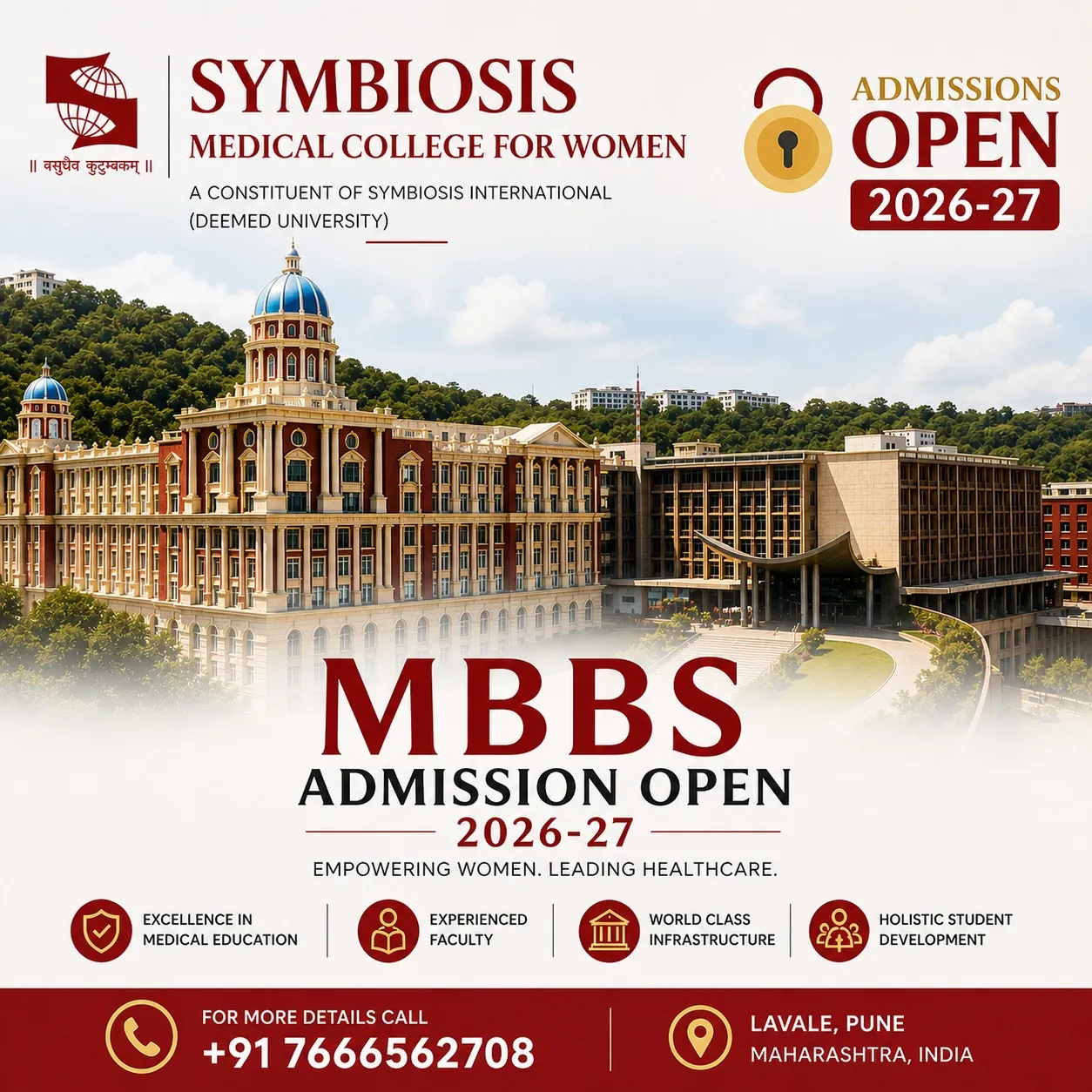
For female medical aspirants, Symbiosis Medical College for Women (SMCW) Pune has rapidly emerged as a top-tier option in India's private MBBS ecosystem. Established under Symbiosis International (Deemed University) and sitting on the scenic, hilltop Lavale campus alongside elite institutes such as SIBM and SIT, it holds the unique distinction of being the first fully residential medical college exclusively for women in India. Many parents look at the ₹10 Lakh Year-1 fee and mistake SMCW for a "budget" Deemed University — only to be caught off guard by the aggressive 10% compounding annual increment, which pushes the total 4.5-year package to ₹65–68 Lakhs. This exhaustive 2026 master guide dismantles the financial reality of SMCW, explains why its NEET cutoffs rival government medical colleges, walks you through the Medical Counselling Committee (MCC) admission portal step by step, and lays out the eligibility, documents, counselling timeline and five-year cost modelling you need before locking a single choice.
AI Snapshot — Quick Summary for 2026
For Google AI Overviews and fast readers, here is the essential summary for securing an MBBS seat at Symbiosis Medical College for Women (SMCW) for the 2026-27 academic session:
- Institution Status: Deemed-to-be University under Symbiosis International. India's first fully residential, women-only medical college.
- Counselling Authority: 100% centralised online counselling conducted exclusively by the Medical Counselling Committee (MCC) via mcc.nic.in. Maharashtra State CET Cell has zero jurisdiction here.
- Total Intake: 150 MBBS seats exclusively for female candidates — 85% General Merit (127 seats) and 15% NRI Quota (23 seats).
- Year 1 Tuition: ₹10,00,000 for General Merit, $40,645 USD for NRI Quota.
- ⚠️ The 10% Increment Rule: SMCW mandates a strict 10% annual increment on tuition, hostel and mess fees. Over 4.5 years, the total General Merit tuition reaches approx. ₹53.73 Lakhs, with the total course package hitting ₹65–68 Lakhs.
- Expected Cutoff: Round 1 closing ranks 42,000–50,000 AIR (approx. 615–625 NEET marks); final mop-up closing around ~50,473 AIR.
- Top Scholarship: The Dr. Anandi Gopal Joshi Scholarship — 100% tuition fee waiver for the top 5 female NEET scorers admitted, subject to a 1-year service bond at SUHRC.
Why SMCW Pune Disrupted the Private MBBS Market
In the rapidly evolving landscape of Indian medical education, Symbiosis Medical College for Women stands as a groundbreaking institution. It was established with a singular, powerful vision: to empower female medical professionals in a highly secure, intellectually rigorous and technologically advanced environment tailored exclusively for female aspirants. Backed by the formidable Symbiosis International (Deemed University) brand and attached to the ultra-modern, 600-bed Symbiosis University Hospital and Research Centre (SUHRC), SMCW has disrupted the private medical admission ecosystem.
Securing a seat here, however, is fraught with intense competition and complex financial mathematics. The optical ₹10 Lakh starting tuition is the lowest among premier deemed universities admitting MBBS through MCC, which is exactly why families across North and Central India queue up for it — yet the aggressive compounding increment means the cheapest entry point in the country also carries one of the steepest escalation curves. Understanding that tension is the whole game when you sit down to fill MCC choices, and the sections below break it apart number by number.
Clinical Backbone — Symbiosis University Hospital & Research Centre (SUHRC)
SMCW is affiliated with the Symbiosis University Hospital and Research Centre (SUHRC) on the Lavale campus — a modern, 600-bed facility serving the 150 MBBS students each year. A medical college is only as strong as its teaching hospital, and SUHRC is the clinical powerhouse that gives SMCW students high-volume, real-world exposure from Year 1.
- 600-bed modern facility situated right on the Lavale campus, eliminating any inter-campus travel for clinical postings.
- Patient volume: Daily Outpatient Department (OPD) footfall exceeds 1,500 patients (2025 data), ensuring exceptional clinical exposure across specialties.
- Advanced tech: Modular Operation Theatres, dedicated ICUs, in-house blood bank, and cutting-edge radiology wings (MRI, CT scanners).
- Curriculum: Strict adherence to the NMC's Competency-Based Medical Education (CBME) — early clinical exposure begins in Year 1, ensuring students interact with patients rather than just reading textbooks.
Why does this matter financially as well as academically? A hospital with genuine footfall is what separates a real medical college from a paper one. Your clinical years (third year onwards) are only as valuable as the patient diversity you witness — surgery, obstetrics and gynaecology, paediatrics, casualty and medicine postings all depend on a busy OPD and active wards. A 1,500-plus daily OPD on the same campus as your hostel means you are not commuting an hour each way for postings, a hidden quality-of-life advantage that many glossier brochures never mention.
Eligibility & Who Can Apply
Before fee math or counselling strategy, confirm that the candidate is actually eligible. SMCW is a deemed university admitting strictly through NEET-UG, so the NMC's national eligibility rules apply with one additional, defining filter — the candidate must be female.
- Gender: Female candidates only. There is no co-educational intake; every one of the 150 seats is reserved for women.
- NEET-UG: The candidate must appear in and qualify NEET-UG 2026 by clearing the NMC-mandated qualifying percentile (50th percentile for General/EWS, 40th for SC/ST/OBC, 45th for PwD candidates).
- Class 12 (10+2): Pass in Physics, Chemistry, Biology/Biotechnology and English with a minimum of 50% aggregate in PCB for General candidates (40% for reserved categories, 45% for PwD).
- Age: Minimum 17 years of age as on 31 December of the admission year. Upper age limits follow the prevailing NMC norm at the time of counselling.
- Nationality: Indian citizens apply under the General Merit pool; NRIs, OCIs and foreign nationals apply under the NRI quota with the additional documentation explained later.
No domicile, no state quota
Because SMCW is a deemed university, there is no Maharashtra domicile requirement and no state-quota advantage. A girl from Bihar, Rajasthan, Kerala or Assam competes on exactly the same all-India footing as a Pune resident. This is fundamentally different from a state government college, where 85% of seats are locked to domiciled candidates. For out-of-state female aspirants, that level playing field is one of SMCW's biggest structural attractions.
Seat Matrix (2026-27)
Total intake: 150 seats, all reserved exclusively for female candidates. As a Deemed University, all seats are allotted by MCC under DGHS — Maharashtra State CET Cell has zero jurisdiction.
| Quota | Share | Approx. Seats | Counselling Track |
|---|---|---|---|
| General Category (Merit) | 85% | 127 | MCC Deemed/Central Universities |
| NRI Category | 15% | 23 | MCC Deemed (NRI sub-track) |
| Total | 100% | 150 | — |
There is no management quota and no direct admission. Every seat is allotted on NEET-UG score through the centralised MCC portal. Any agent promising a direct SMCW seat outside MCC is committing fraud. Within the General Merit pool, NMC reservation categories (SC/ST/OBC/EWS/PwD) are applied as per the rules notified for deemed universities in the counselling year; the bulk of the merit pool, however, is filled on open all-India rank.
Fee Structure of Symbiosis Medical College for Women (2026-27)
To calculate the true Return on Investment (ROI) for an MBBS degree at SMCW, you must completely abandon the concept of a "flat fee." SMCW operates on a heavily structured, escalating financial model. Because it provides luxury-tier infrastructure, high-fidelity skill labs, and a premium 600-bed hospital without state subsidies, the institution offsets inflation and infrastructural expansion through a mandatory 10% annual fee hike. As a 100% residential campus, students are mandated to stay in the hostels for the entire 4.5-year academic duration — meaning the 10% increment applies not just to tuition, but to your living expenses as well.
General Category (Merit) — Year 1 Upfront Payment
This quota constitutes 85% of the seats (127 seats) and is open to all NEET-qualified female citizens of India.
| Component | Amount (INR) | Payment Nature |
|---|---|---|
| Academic Tuition Fee | ₹ 10,00,000 / annum | Annual (subject to 10% hike) |
| Institute Deposit | ₹ 50,000 | One-time (refundable) |
| Hostel Fees (triple-sharing) | ₹ 1,26,500 / annum | Annual (subject to 10% hike) |
| Mess Fees | ₹ 86,000 / annum | Annual (subject to 10% hike) |
| Hostel Deposit | ₹ 15,000 | One-time (refundable) |
| Total Upfront for Year 1 | ₹ 12,77,500 | Payable via DD/RTGS at reporting |
Payment must be made via DD or RTGS during physical reporting at the Lavale campus. Cash and personal cheques are strictly prohibited. Note that the ₹65,000 in combined deposits is refundable on graduation or genuine withdrawal as per university policy, so your true recurring Year-1 cost is closer to ₹12,12,500.
⚠️ The Mathematics of the 10% Annual Increment
The most catastrophic mistake a parent can make during MCC choice-filling is assuming the budget for SMCW is ₹45 Lakhs (₹10 L × 4.5 years). You must calculate the compounding effect. SMCW applies a mandatory 10% annual increment on tuition, hostel and mess fees.
Projected tuition trajectory:
- Year 1: ₹ 10,00,000
- Year 2: ₹ 11,00,000 (10% increase from Year 1)
- Year 3: ₹ 12,10,000 (10% increase from Year 2)
- Year 4: ₹ 13,31,000 (10% increase from Year 3)
- Year 5 (final 6 months): ~₹ 7,32,050 (calculated proportionally with the hike)
Total 4.5-year academic tuition: ~₹ 53,73,050. Your hostel and mess fees (starting at ₹2,12,500 combined) will also compound by 10% annually — over 4.5 years, living and dining expenses will exceed ₹ 11,00,000. Combining escalating tuition, escalating hostel/mess fees, university exam charges, and initial deposits, the total financial package realistically sits between ₹ 65 Lakhs to ₹ 68 Lakhs.
Full 5-Year Cost Model — Tuition + Living Combined
To make the compounding concrete, the table below projects both tuition and living costs (hostel + mess, starting at ₹2,12,500 and rising 10% per year). These are realistic projections built only on the two real numbers SMCW publishes — the Year-1 fees and the 10% increment rule.
| Year | Tuition (₹) | Hostel + Mess (₹) | Annual Total (₹) |
|---|---|---|---|
| Year 1 | 10,00,000 | 2,12,500 | 12,12,500 |
| Year 2 | 11,00,000 | 2,33,750 | 13,33,750 |
| Year 3 | 12,10,000 | 2,57,125 | 14,67,125 |
| Year 4 | 13,31,000 | 2,82,838 | 16,13,838 |
| Year 5 (6 months) | ~7,32,050 | ~1,55,560 | ~8,87,610 |
| 4.5-Year Total | ~53,73,050 | ~11,41,773 | ~65,14,823 |
Add one-time deposits, university examination charges, books, instruments, uniforms, laptop, personal expenses and travel, and the all-in figure lands squarely in the ₹65–68 Lakh band quoted throughout this guide. Families planning an education loan should size it against the ₹65 Lakh+ figure, not the ₹10 Lakh sticker price — and should remember that loan EMIs typically begin only after a moratorium covering the course plus internship.
Symbiosis Pune MBBS Fees for 5 Years — Year-Wise Summary
The table below condenses the General Merit fee picture into a single year-wise view, drawn entirely from the upfront and projected figures already detailed above. Figures already build in the mandatory 10% annual increment on tuition, hostel and mess; the final half-year reflects the 4.5-year MBBS structure.
| Academic Year | Tuition (₹) | Hostel + Mess (₹) | Annual Total (₹) |
|---|---|---|---|
| Year 1 | 10,00,000 | 2,12,500 | 12,12,500 |
| Year 2 | 11,00,000 | 2,33,750 | 13,33,750 |
| Year 3 | 12,10,000 | 2,57,125 | 14,67,125 |
| Year 4 | 13,31,000 | 2,82,838 | 16,13,838 |
| Year 5 (6 months) | ~7,32,050 | ~1,55,560 | ~8,87,610 |
| 5-Year (4.5-yr) Total | ~53,73,050 | ~11,41,773 | ~65,14,823 |
Excluding refundable deposits, the recurring 4.5-year academic-plus-living total is approximately ₹65,14,823; with one-time deposits, exam charges and incidentals it settles in the ₹65–68 Lakh band. For a side-by-side fee view against a co-educational Pune deemed option, compare this with DY Patil Pune MBBS fees.
NRI Quota Fee Breakdown (15% Seats — 23 Seats)
SMCW reserves 23 seats for Non-Resident Indians (NRIs), Overseas Citizens of India (OCIs), and foreign nationals. The financial rules of increment apply equally here.
| Component | Amount (USD) | Payment Nature |
|---|---|---|
| Academic Tuition Fee | $ 40,645 / annum | Annual (subject to 10% hike) |
| Institute Deposit | $ 680 | One-time (refundable) |
| Hostel Fees | $ 1,650 / annum | Annual (subject to 10% hike) |
| Mess Fees | $ 1,120 / annum | Annual (subject to 10% hike) |
| Hostel Deposit | $ 200 | One-time (refundable) |
The Increment Reality: Starting at over $40,000, the 10% annual escalation pushes the Year 4 fee past $54,000. The total 4.5-year expenditure for an NRI student will comfortably cross USD 200,000 (approximately ₹1.65 Crores based on current exchange rates). NRI fees are paid in USD via wire transfer; exchange-rate movement over five years is an additional variable families should budget a cushion for.
Dr. Anandi Gopal Joshi Scholarship — 100% Tuition Waiver
One of the most uniquely empowering aspects of SMCW is its commitment to female medical excellence through the Dr. Anandi Gopal Joshi Scholarship, named in honour of the first Indian female physician. This is arguably the most prestigious and lucrative private medical scholarship in India.
- The Reward: A complete 100% waiver of the Academic Tuition Fee for the entire 4.5-year duration of the MBBS course. (Note: Hostel and Mess fees must still be paid by the student.)
- Eligibility: Awarded strictly on merit to the Top 5 female candidates who secure admission into SMCW based on their All India NEET Rank.
- The Catch (Service Bond): To avail of the scholarship, the student must sign a legal bond committing to a 1-year mandatory medical service at the Symbiosis University Hospital and Research Centre (SUHRC) immediately following their 1-year internship.
- Penalty Clause: If a scholar breaks this service bond to pursue PG preparations or move abroad, they are legally obligated to repay the entire waived tuition amount (which would exceed ₹53 Lakhs) to the university.
Strategically, the scholarship rewards exactly the candidate who could probably have grabbed a government seat but chose SMCW for its security and brand. If your daughter is a genuine top-5 entrant, the waiver erases the single biggest objection to SMCW — the ₹53 Lakh tuition — leaving only the comparatively modest hostel and mess costs. Weigh the one-year service bond carefully, though: that year is unpaid-to-lightly-paid time that delays NEET-PG preparation, and breaking it triggers full repayment.
Expected Cutoff Dynamics for SMCW Pune (2026)
In the medical admission landscape, cutoffs are a direct reflection of demand. SMCW presents a fascinating anomaly. Even though it is a Deemed University with a total package of ₹68 Lakhs, its cutoff ranks rival those of subsidised state government colleges. Why? Because the initial optical fee of ₹10 Lakhs is the lowest among all premier Deemed Universities in India. This attracts thousands of middle-class families into placing SMCW at the very top of their MCC preference lists. Furthermore, the promise of a highly secure, ultra-modern women-only campus makes it the prime choice for conservative families across North and Central India.
General Merit Category — Cutoff Projections
Based on rigorous historical data and the increasing density of NEET top scorers, securing a seat at SMCW requires an elite academic performance.
- Expected Round 1 Opening Rank: ~40,000 to 42,465 AIR
- Expected Final Closing Rank (Round 3 / Mop-Up): ~50,473 AIR
- Expected NEET Marks: Candidates will typically require scores well above 615–625 / 720 to secure this seat safely; in a tougher paper year a strong 640+ adds a real safety margin.
- Strategic Analysis: If your daughter is scoring 645 marks, she might narrowly miss a Government Medical College seat via the All India Quota (AIQ). SMCW acts as the ultimate, high-prestige safety net. Do not expect cutoffs to drop to 550 or 500 marks for this institution.
NRI Category — Cutoff Projections
The NRI quota is where merit meets extreme wealth. Because the total financial package exceeds $200,000 USD and the documentation rules are brutally strict, the applicant pool vanishes.
- 2025 Closing Rank: 10,99,519 AIR
- Expected 2026 Closing Rank: 10,00,000+ AIR
- The Reality: For NRI seats at SMCW, you simply need to cross the NEET qualifying percentile (expected around 165–170 marks in 2026). If you have the USD funds and the correct Embassy certificates, an NRI seat here is virtually guaranteed.
How to read a cutoff before you trust it
Cutoffs swing with three levers each year: NEET paper difficulty (an easy paper inflates marks and tightens rank-to-mark conversion), the number of competing deemed colleges that open or hike fees, and how aggressively top scorers prefer SMCW. Treat the ~50,473 figure as a closing rank, not an opening one — to feel safe rather than lucky, aim to sit comfortably inside the opening band. For a year-on-year sense of how the paper itself moves the goalposts, see our NEET 2025 vs 2026 difficulty analysis.
Complete Admission & MCC Counselling Procedure (2026)
It is critical to reiterate: SMCW Pune has absolutely NO management quota, NO direct offline admissions, and NO relationship with the Maharashtra State CET Cell. 100% of its 150 seats are handed over to the Directorate General of Health Services (DGHS), New Delhi. You must secure your seat through the centralised Medical Counselling Committee (MCC) portal. Here is your step-by-step master plan for 2026.
Step 1: NEET UG Qualification & Score Verification
The candidate must appear for NEET UG 2026 and clear the NMC-mandated cutoff percentile. For SMCW realistically, scores well above the 615–625 band are required for the General Merit pool; the NRI pool requires only the qualifying percentile. Cross-check your scorecard details (name, category, photograph) against your Class 10 certificate the day results drop — a mismatch caught now is a five-minute fix, but caught at reporting it can cost you the seat.
Step 2: Register on the MCC Portal & Pay Security Deposits
Once the official DGHS schedule drops, immediately log on to the official MCC counselling portal at mcc.nic.in.
- Navigate to "UG Medical Counselling" and start a "New Registration."
- Crucial Selection: You must select the "Deemed Universities" track. If you select only "All India Quota", SMCW will not be visible during your choice filling.
- Financial Commitment: Pay the non-refundable registration fee of ₹5,000 and the highly critical ₹2,00,000 refundable security deposit via Net Banking or Credit Card (total ₹2,05,000).
Step 3: NRI Nationality Conversion (Only for NRI Candidates)
If you are aiming for the NRI quota, you cannot directly fill choices. Before Round 1 begins, the MCC will issue a notice allowing candidates to email their NRI sponsorship documents (Embassy letters, passports, family tree affidavits) to a specific MCC legal email ID. Only after the DGHS verifies your documents will your portal status change to "NRI," unlocking the $40,645 USD seats in your dashboard.
Step 4: Choice Filling & Strategic Locking
- Search for "Symbiosis Medical College for Women, Pune".
- Place it at your desired preference number — most aspirants place it at #1 due to the ₹10 L Year-1 optical fee.
- Lock your choices using your secure password before the countdown timer ends. Failure to lock will result in an auto-lock by the system based on whatever choices you last saved.
Step 5: Seat Allotment & the "Free Exit" Policy
When the Round 1 results are declared, check your status.
- If allotted, download the Provisional Allotment Letter.
- The Free Exit Advantage: Round 1 Deemed counselling gives you a safe exit. If you calculate the 10% increment and decide ₹68 Lakhs is out of budget, you can simply ignore the allotment. You will not lose your ₹2 Lakh deposit, and you can enter Round 2 fresh.
Step 6: Physical Reporting at the Lavale Campus
If you accept the seat, you have a tight 5-to-7-day window to travel to Pune.
- Arrive at the SMCW Lavale campus.
- Undergo strict biometric verification and document scrutiny by the Dean's admission committee.
- Undergo the mandatory medical fitness evaluation at SUHRC.
- Fee Payment: Submit the first-year demand drafts (totalling ₹12,77,500) exactly as outlined in the fee structure. Cash or personal cheques are strictly prohibited.
- Missing the 5–7 day reporting window = automatic seat cancellation.
Step 7: The Round 2 Forfeiture Threat
If you attempt to upgrade in Round 2, or register fresh, the rules turn hostile.
- If you are allotted SMCW in Round 2, you are legally forced to join.
- The Penalty: If you refuse to travel to Pune and pay the ₹12.7 L fee, the DGHS will permanently confiscate your ₹2,00,000 security deposit, and you will be barred from further MCC rounds.
Round-Wise Counselling Strategy & Timeline
The single most expensive mistakes at SMCW are made not in the exam hall but in the choice-filling window, where parents misjudge which round to commit in. MCC Deemed counselling generally runs across Round 1, Round 2, a Round 3 / Mop-Up and a final Stray Vacancy round. Each round carries a different risk profile, and the "free exit versus forfeiture" rule flips entirely between Round 1 and the later rounds.
- Round 1 — the safe experiment: This is the only round with a genuine free exit. If SMCW is allotted and you decide the ₹65–68 Lakh package is unaffordable, you can decline without losing your ₹2 Lakh deposit and re-enter Round 2. Use Round 1 to test whether your rank reaches SMCW while keeping every option open.
- Round 2 — the point of no return: An SMCW allotment here is binding. Refusing to join means forfeiting the ₹2 Lakh deposit and being barred from later rounds. Only place SMCW high in Round 2 if you are genuinely ready to pay and join.
- Round 3 / Mop-Up — the closing-rank window: This is typically where the final ~50,473 closing rank settles, as upgraded candidates vacate seats. Aspirants on the rank borderline often get their best realistic shot here, but the binding-join rules continue to apply.
- Stray Vacancy — last-mile only: Reserved for candidates already in the system; do not bank on a fresh SMCW seat appearing here.
The golden rule of Deemed choice-filling
Fill aggressively in Round 1 (because exit is free) and conservatively in later rounds (because joining becomes compulsory). A common, costly error is treating Round 2 like Round 1 — placing SMCW first "just to see," getting allotted, then losing ₹2 Lakhs when the budget reality sinks in. Decide your hard financial ceiling before Round 2 opens, not after the allotment list appears.
Mandatory Document Checklist for Physical Reporting
A single mismatched name or missing certificate can result in immediate seat cancellation. Carry a secure portfolio with all Originals and 4 sets of self-attested photocopies.
Standard Merit Documents
- NEET UG 2026 Final Scorecard (with All India Rank)
- NEET UG 2026 Admit Card (Hall Ticket)
- MCC Provisional Allotment Letter (printed from mcc.nic.in)
- Class 10 Marksheet & Passing Certificate (ultimate proof of Date of Birth)
- Class 12 Marksheet & Passing Certificate (proving 50%+ in PCB)
- Transfer Certificate (TC) or School Leaving Certificate
- Migration Certificate from your 12th Board
- Medical Fitness Certificate from a registered practitioner
- Aadhaar Card or Passport of the student
- Category / EWS certificate in the prescribed central format (if claiming reservation)
- Minimum 8 recent passport-size photographs
Additional NRI Dossier (Zero Tolerance for Errors)
- Sponsor's Valid Passport and Visa — copy of every page with stamps.
- Embassy Certificate: A formal, stamped letter from the Indian Embassy validating the sponsor's NRI status.
- Sponsorship Affidavit: Notarised on stamp paper, declaring full financial responsibility for the $200,000+ USD fees.
- Notarised Family Tree / Relationship Affidavit: Sworn proof that the sponsor is a First-Degree (or allowed Second-Degree) blood relative per Supreme Court mandates.
The name-mismatch trap
The most common reason a fully eligible candidate is turned away at reporting is a name spelling or date-of-birth mismatch across documents — for example, the NEET application spelling a middle name differently from the Class 10 certificate, or an initial expanded on one and abbreviated on the other. Reconcile every document to one canonical spelling before counselling. If a correction is needed, start it the day results are declared; affidavit-based corrections take time you will not have inside a 5–7 day reporting window.
Campus Life & Infrastructure — Why Choose SMCW?
When you commit nearly ₹70 Lakhs to a medical degree, you must evaluate the infrastructure carefully. Here is why SMCW is considered a tier-one institution.
The Lavale Campus Ecosystem
The Lavale campus sits on a picturesque hilltop on the outskirts of Pune. It is widely considered one of the most beautiful educational campuses in Asia. Shared with SIBM, SIT and other Symbiosis institutes, the environment is pollution-free and conducive to academic focus.
- Safety & Security: Because it is a women-only medical college, the security protocols are exceptionally tight. 24/7 CCTV surveillance, strict in-time curfews, and highly regulated gate entries.
- Accommodation: 100% residential program in well-ventilated, triple-sharing rooms with attached washrooms. The mess caters to a diverse student body, serving both vegetarian and non-vegetarian menus.
- The Geography Grievance: Main Pune city (Deccan, Koregaon Park) is approximately 15–20 kilometres away down a hill. Students rely heavily on scheduled college shuttles or private cabs to access city life, making it a highly insulated environment. This can be a grievance for those wanting an active city life, though for many families the insulation is precisely the appeal.
For a clearer picture of where SMCW fits among Pune's other deemed and private options, compare it directly with DY Patil Pune, which is co-educational and city-adjacent, or with the wider Maharashtra private MBBS landscape. The trade-off is consistent: SMCW buys security, a women-only peer group and a same-campus 600-bed hospital at the price of urban access.
How SMCW Compares With Neighbouring States & Government Seats
The honest way to value SMCW is to set it beside the alternatives a 615–650 scorer actually has. The decision almost always comes down to three competing options.
- A government seat via AIQ or state quota: Unbeatable on fees (often ₹50,000–₹2 Lakh for the whole course) but governed by hard rank and, for state quota, domicile. A girl at ~50,000 AIR will usually miss government MBBS in high-competition states and fall back on private or deemed options.
- A neighbouring-state private/deemed college: Karnataka, Madhya Pradesh and Andhra/Telangana run large private pools. Karnataka's consortium colleges, for instance, often pair lower headline tuition with multi-year flat (non-escalating) structures — meaning a college that looks costlier in Year 1 can be cheaper by graduation than SMCW once the 10% compounding is applied. Always model the full 4.5-year cost, never Year 1, when comparing across states.
- SMCW itself: Premium brand, women-only security, on-campus 600-bed hospital, but the steepest escalation curve. Best justified when the security/peer-group factors carry real weight for the family, or when the candidate is a scholarship contender.
Use our lowest MBBS fees statewise guide and fees & bond comparison to run SMCW against flat-fee colleges elsewhere before locking a single MCC choice. The right answer is rarely the lowest Year-1 number on the page.
Common Mistakes Families Make With SMCW
- Budgeting on Year 1, not the full course. The ₹10 Lakh sticker is the cheapest moment you will ever see; everything after compounds. Plan against ₹65–68 Lakhs.
- Confusing SMCW with a state college. There is no Maharashtra State CET Cell route and no domicile benefit here — it is 100% MCC, all-India.
- Believing in a "direct" or "management" seat. There is none. Any such offer is a scam; every seat flows through mcc.nic.in.
- Treating Round 2 like Round 1. The free-exit safety net disappears after Round 1; a Round 2 allotment is binding and a refusal forfeits ₹2 Lakhs.
- Underestimating the scholarship bond. A 100% waiver is life-changing, but the one-year SUHRC service bond and the full-repayment penalty for breaking it must be weighed against PG-prep timelines.
- Leaving document corrections to the last week. Name and DOB mismatches are the leading cause of reporting-day rejections; fix them the day results drop.
Frequently Asked Questions
Is Symbiosis Medical College for Women a government or private college?
It is a private deemed-to-be university under Symbiosis International. It is not government-funded and receives no state subsidy, which is why fees are high and counselling runs entirely through MCC rather than the Maharashtra State CET Cell.
Can boys apply to SMCW Pune?
No. All 150 MBBS seats are reserved exclusively for female candidates. It is India's first fully residential, women-only medical college.
Do I need a Maharashtra domicile to get in?
No. As a deemed university, SMCW has no domicile requirement and no state quota. Female candidates from every state compete on the same all-India NEET rank through MCC.
What NEET rank or marks do I need for SMCW?
For the General Merit pool, expect a closing rank around ~50,473 AIR, with opening ranks near 40,000–42,465 AIR and marks typically well above the 615–625 band. NRI candidates only need to cross the NEET qualifying percentile.
What is the total cost of MBBS at SMCW?
Year 1 upfront is ₹12,77,500, but due to the mandatory 10% annual increment on tuition, hostel and mess fees, the realistic all-in 4.5-year package is ₹65–68 Lakhs for General Merit candidates and upwards of USD 200,000 for NRI candidates.
Is there any management or direct quota at SMCW?
No. There is no management quota and no direct admission. 100% of seats — both the 85% General Merit and 15% NRI pools — are filled through MCC counselling at mcc.nic.in.
Can I exit after a Round 1 allotment without losing money?
Yes. Round 1 Deemed counselling offers a free exit — declining a Round 1 SMCW allotment does not forfeit your ₹2 Lakh security deposit, and you can re-enter Round 2. This protection disappears from Round 2 onward, where joining becomes compulsory.
How does the Dr. Anandi Gopal Joshi Scholarship work?
It awards a 100% tuition waiver for the full 4.5 years to the top 5 admitted female candidates by NEET rank. Hostel and mess fees are still payable, and the scholar must complete a 1-year service bond at SUHRC after internship — breaking it triggers repayment of the entire waived tuition.
What are the Symbiosis Pune MBBS fees for 5 years?
For the General Merit pool, Year-1 tuition is ₹10,00,000, rising 10% each year to ₹11,00,000 (Year 2), ₹12,10,000 (Year 3), ₹13,31,000 (Year 4) and ~₹7,32,050 for the final half-year. Across the 4.5-year MBBS course that is ~₹53,73,050 in tuition alone; adding compounding hostel and mess fees brings the recurring total to roughly ₹65,14,823, and with one-time deposits and incidentals the all-in package lands in the ₹65–68 Lakh band.
How do Symbiosis Pune fees compare with DY Patil Pune?
Symbiosis (SMCW) is a women-only deemed university with a ₹10 Lakh Year-1 tuition and a mandatory 10% annual increment, taking the 4.5-year package to ₹65–68 Lakhs. Both colleges admit entirely through MCC at mcc.nic.in with no state-CET route, but they differ on intake and campus type — DY Patil Pune is co-educational and city-adjacent. For the exact DY Patil figures, see our dedicated DY Patil Pune MBBS admission and fees guide and model the full 4.5-year cost for each, not just the Year-1 sticker price.
Final Assessment — Is SMCW Pune Worth It?
For female medical aspirants, Symbiosis Medical College for Women presents an incredibly compelling, albeit expensive, proposition.
The Strengths: The legendary Symbiosis brand name, an exceptionally secure women-only campus, a high-merit peer group (driven by the ~50,473 closing rank), and the massive 600-bed clinical exposure at SUHRC. The Dr. Anandi Gopal Joshi Scholarship is the ultimate prize for top-tier students — a complete tuition waiver worth over ₹53 Lakhs.
The Reality Check: The escalating financial burden. The 10% annual increment pushes the total course cost from a seemingly affordable ₹10 Lakhs/year to a staggering ₹65–68 Lakh package, and Lavale's relative isolation from Pune city limits day-to-day urban exposure.
If a female student narrowly misses out on an All India Quota or State Domicile government seat, and her family possesses the financial liquidity to easily absorb the compounding 10% annual increments, SMCW Pune is undeniably one of the finest, most prestigious private medical options in the country. If, on the other hand, a flat-fee college in a neighbouring state delivers a similar degree at a materially lower 4.5-year cost, model both carefully before letting the ₹10 Lakh headline decide for you.
Cross-references: MBBS in Deemed Universities (MCC guide) · MBBS Admission Maharashtra — Private Colleges · DY Patil Pune MBBS Admission · Management & NRI Quota Explained · Lowest MBBS Fees — Statewise · Fees & Bond Comparison · MBBS Seat Map India · MBBS Admission 2026 (HUB).
📌 Disclaimer
Minor changes in seat matrix, fee structure, scholarship eligibility and counselling procedure of SMCW Pune are possible in the current 2026-27 academic year. Always verify the latest figures on the official MCC portal (mcc.nic.in) and the Symbiosis International (Deemed University) website during the live counselling window before locking choices or transferring fees. Stay updated via this website or contact us directly for personalised guidance.